I began my travels by driving from my home in Southern France with my friends Jan and Tom to visit Tom’s brother in Valencia. Arriving by car in Valencia during the Fallas festival is a challenge. Many streets become pedestrian only in the Ruzafa neighborhood where most street corners have a Fallas. A Fallas is a statue (or series of statues called ninots) made out of cardboard, wood, paper-machè and/or plaster. Many of the statues reach towering heights, of 2-3 stories.
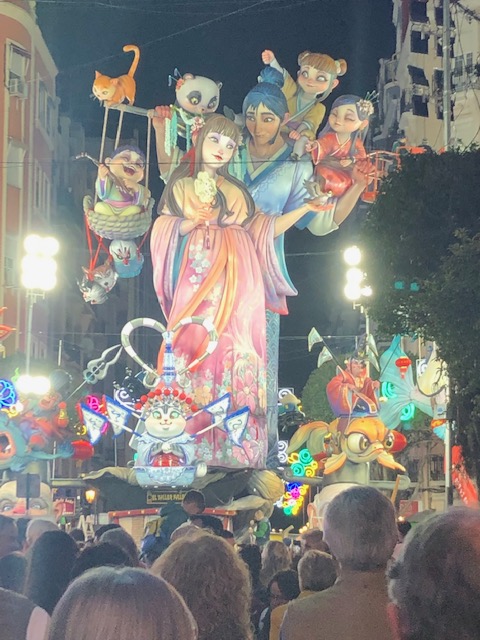
Fallas’ roots are in the Christian church, originally celebrating St Joseph, Jesus’ adoptive dad. Today, however it mostly showcases Catalan traditions, artistry and social/political commentary though the flower procession is still very religiously significant.
I was lucky to be welcomed into the home of Tom’s brother Paul who lives right in the center of the Fallas activity and so I was able to appreciate the vibrant street life of it with a convenient double-glazed window refuge from the intensity! We had balconies looking down onto two different streets and a lively street corner where a Fallas installation was having it’s final decorative details added as we arrived on March 15th. This shows Tom and Paul on Paul’s balcony. Notice one of the ninots has been installed on the balcony below his.

Each Fallas is conceived of, paid for and supervised 24/7 during all five days of the festival. In the blocked street near each intersection they set up a white tent and a fenced off area as their casal, headquarters. In the white tent rotating crews prepare and serve meals to the festival participants from their club. I noticed that the security and general personnel were of all ages, but the younger members tended to take the later shifts and the older ones, the early shift.
At dinner time we ventured out for our first stroll around the block and saw stalls selling churros, paella and tapas as well as places to buy items made from a fabric on which is printed that year’s Fallas motif. The streets were crowded, especially at the intersections where people pressed to get close enough to the Fallas to read the explanatory signs that were part of each display to help spectators understand the theme of the display.
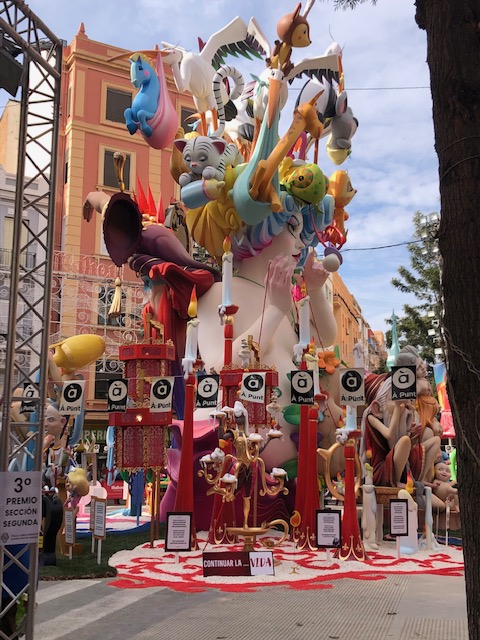
Messages tended to be written in Valenciana, a language similar to Catalan, but not easily comprehensible for someone like me who only has a nodding acquaintance with Castillian Spanish. So I really didn’t understand most of the underlying commentary of the Fallas, but could appreciate the imagination, artistry and the commitment that went into their creation. A few were visually explicit enough even for me. For example, this criticism of our social media addiction (though I’m not sure how much impact this ninot had, as these four young men were seated directly opposite it!).


Our stroll was accompanied by the sound of small cherry bomb fire crackers being thrown by people walking amongst us and the occasional boom of a much larger one, but even I did not feel overwhelmed or threatened (and I’m sensitive to crowds and explosives and super sensitive to the two combined!).
The next morning we took a more extensive stroll to look at the street activities and could get closer to the Fallas (there were at least twenty in a one kilometre radius) and also walked through the large Plaza del Ayuntamiento, but on purpose, we were far enough away by 2PM (in the Turia river bed gardens) not to be overwhelmed when the Mascletà started, though it did cause all conversation to halt. The Mascletà is a massive explosion of firecrackers that happens daily from March 1-19. The noise reaches 120 decibels and is so powerful that your chest is compressed and if you don’t open your mouth, your eardrums will be damaged. We visited a cool playground in which a huge reproduction of Gulliver while tied up by the Lilliputians forms the center point for adults and children to climb and slide on.

We returned home in time to shelter from the Friday night craziness as twice as many people and five times as many firecrackers took over the streets from 8PM to 6AM. Despite waking several times during the night to look out the window, I never saw any extreme behaviour: no fighting, vomiting or vandalism. There was one argument under our window at about 6am, but the women in the party physically kept the two arguing guys apart as did the more reasonable guys.
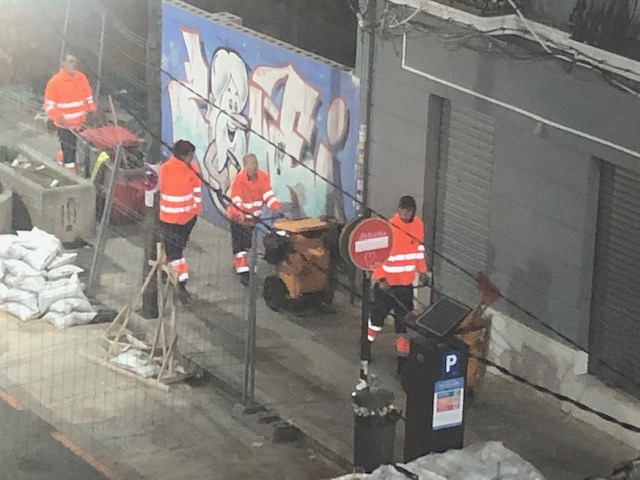
Although the trash cans were overflowing, most of the trash was in the vicinity of the cans and there was a literal army of street cleaners deployed between 6:30 AM and 9:00AM so that by the time street traffic resumed, it was spotless.

It’s hard to describe how pervasive the festivities were. At first, when we would hear a band, we’d rush out to the street and follow the sound to find a whole gathering of women of all ages dressed in traditional dress (many passed down from generation to generation costing as much as a second hand car) either led or followed by a marching band composed of about 15 people.
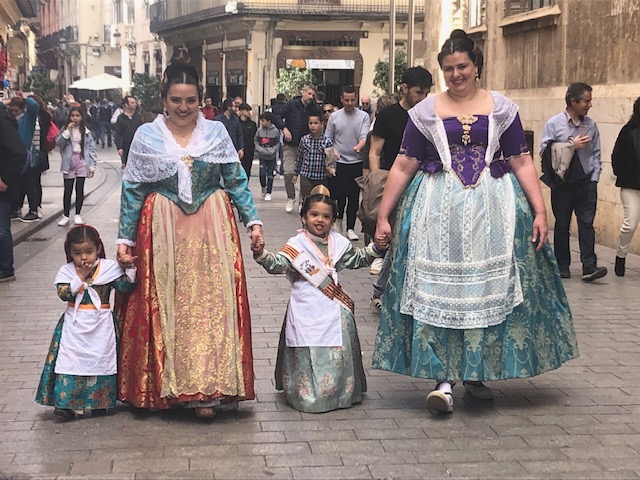
Providing the music are traditional chirimias and drums, and resounding throughout the city are Spanish rumbas and boleros, marches and waltzes, or modern rock music – each Fallas Commission does its own thing. The parade would sometimes include men and boys in traditional dress as well, but this wasn’t always the case.
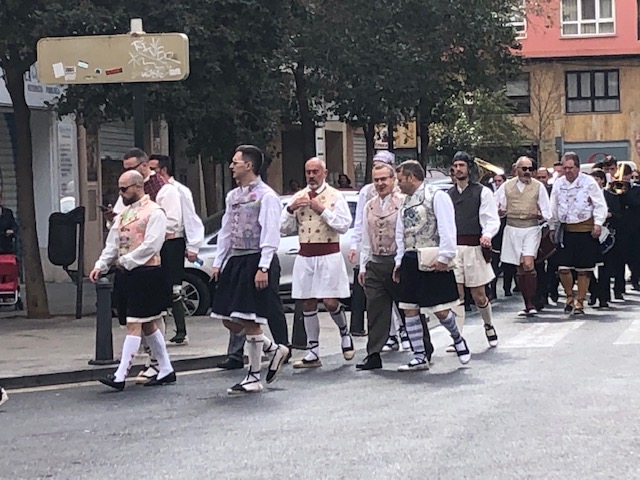
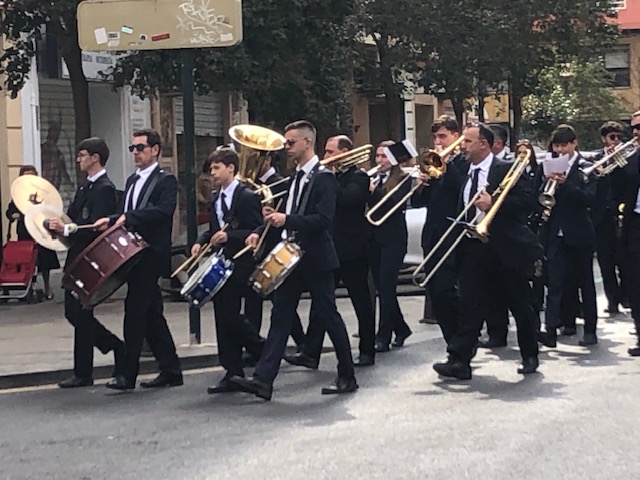
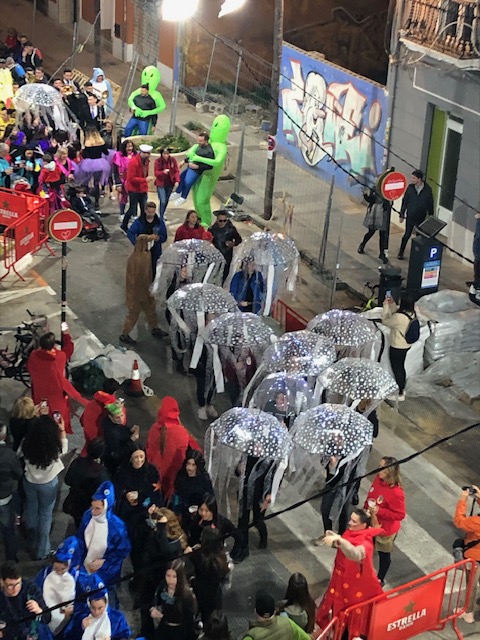
After the first day, the sound of a band had us heading to our perfectly located balcony to observe the progress of the group. By the end of the five day festival, we’d get off the couch, go to the windows and checked they were securely fastened! Not quite, we weren’t that blasé, but close. We only saw one parade that was a break with tradition. Instead of wearing the traje de valenciana (clothes styled mostly after the 18th and 19th century) our neighborhood put one parade on with an oceanic theme: jelly fish, sharks and even a walrus (though there were some inexplicable aliens), but no one minded as they were GREAT costumes.
On the 17 and 18th of March, the parades from each block met at their casal at tightly scheduled times as they all had the same destination, the Ofrenda (offering) to the virgin: our lady of the forsaken. From all parts of the city the groups converge on the Plaza de la Virgen, accompanied by musical groups and carrying bunches of flowers to be placed at the feet of the figure of the Virgin. These small bouquets are then added to the large wooden lattice work that forms the structure of the statue’s robe. Acrobatic men and women to whom the bouquets are tossed when they get to the higher reaches of the robe place the bouquets to form a predetermined mosaic pattern.


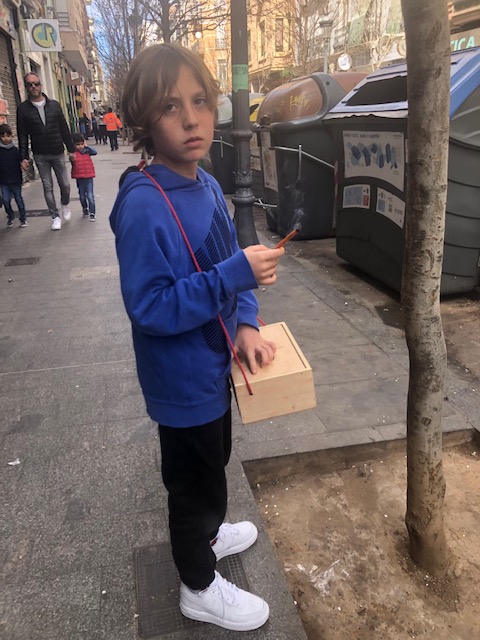
So back to the theme of firecrackers, as you really need to understand how pervasive and impressive this aspect of Fallas is (especially if you are considering coming one year!). We saw multiple stores in the Ruzafa neighborhood selling pirotecnia and each store had a line outside it! Parents buy wooden boxes for their young children to wear around their necks in order to make it easier for them to light and throw firecrackers as they walk through the neighborhood.

The youngest child we saw throw a cherry bomb was about 14 months old. It would be dangerous of course for a child to have a match or lighter (!) so the children are given slow burning snake-like things that have one glowing tip, hot enough to light a fuse. The children are for the most part walking with their parents and we honestly didn’t see anyone using this privilege destructively or dangerously, although they were thrown into crowds, it was only at people’s feet. This child however was unhappy I took his photo (even though his dad agreed to it) and I quickly left after he gave me this dirty look. Later I saw him throw a firecracker that landed so close to his dad that his father was rubbing his leg for minutes afterwards.
More frightening to me were the young men who would buy much more powerful firecrackers that were loud enough to really hurt your ears and cause an involuntary exclamation. These were deceptively small looking, so it was difficult to know when to prepare yourself, even if you happened to see one tossed. Luckily these really loud ones tended to be saved for later in the day, so we found if we got home around 5:00-6:00PM, we could enjoy them from a safe distance.
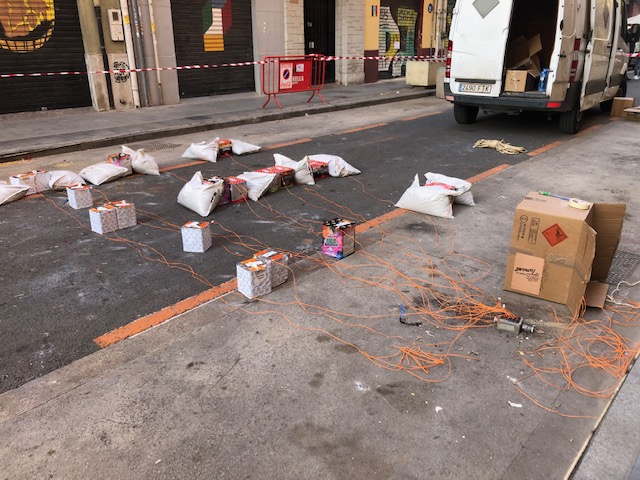
One evening however as we gratefully made our way back into our home, we noticed that a whole network of explosives had been set up just outside our building. Paul asked around and learned this was due to be set off at 9:00PM. At the appropriate time, we paused our viewing of Shrinking (a fabulous show!) and listened entranced as the explosions created a continuous wave of noise which lasted about five minutes. Jan said she detected a rhythm within it, but I thought of it more as the early heavy metal noise avalanche of an AC/DC concert in the 80s (measured at 130 decibels).
In order to get a better understanding of the meaning of the Fallas tradition of making ninots, I went to the museum where one ninot from every year is “pardoned”. This means that it is saved from the annual tradition of burning all the Fallas on March 19th. I have to admit that the current style of the Fallas designs seems to me to be heavily influenced by a Disney style and does not suit my taste. I was pleased to see in the museum that this has not always been so.
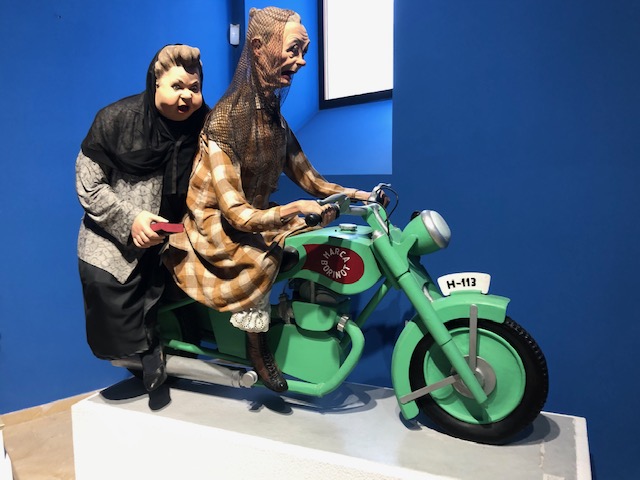
The messages of the ninots have changed over time as you might expect and so have the materials used and the artistic choices that went into them. In the 30s and 40s they depicted traditional Valencian scenes. They were made from wax, wood and cloth and showed craftsmen and popular current figures. In the 50s there developed a sense of narrative which addressed social issues like the shortage of basic goods in the post-war period. Thin cardboard sheets were also coming into use as a layering technique to make more detailed faces. I especially liked this ninot of two old biddies on their way to mass, which coincidentally was from the year of my birth 1958.
In the ’60s satire about the quickly evolving social changes of society were illustrated but by ’70s caricature like figures used humour to entertain, with hardly any political content. Polyester was first used during this time. In the ’80s and ’90s there was a return to focusing on traditional crafts but with a regretful nostalgic sense. This is also when expanded polystyrene began to be used.
As the materials used became more chemical based, the environmental wisdom of burning them all began to be questioned, but so far no changes to tradition are planned. The tradition began because carpenters (and Joseph was a carpenter) used to burn their extra cuts of wood after the winter. Today, the burning of the fallas has come to mean a symbolic rite of cleansing, where all the bad events of the previous year are left behind and start the new season with a fresh, positive attitude.
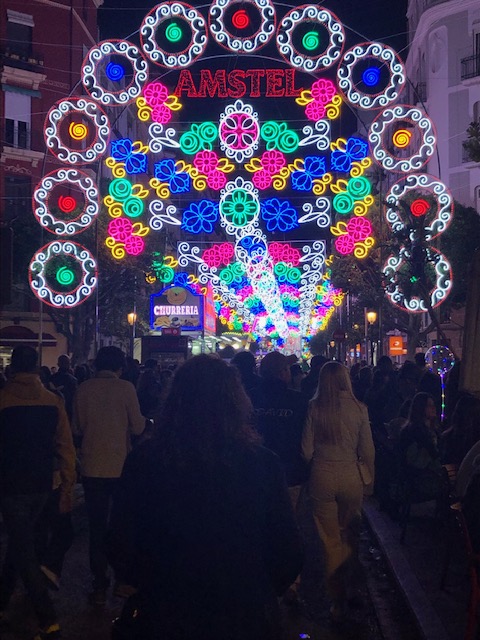
However there have been some recent regulations put in place, for example a limit was put on the amount of money that can be spent on a Fallas. It is currently at 1 million Euros (!). The Fallas are judged based on different criteria and categories and recently the decision was taken to have negative points for any display that included sound effects (music, etc) as a way to protect the rights/sleep of the people who live in the neighborhood. This block for example instead of a Fallas invested in a sound and light show where the lights “danced” to the beat of the music. This year however it was only a light show.
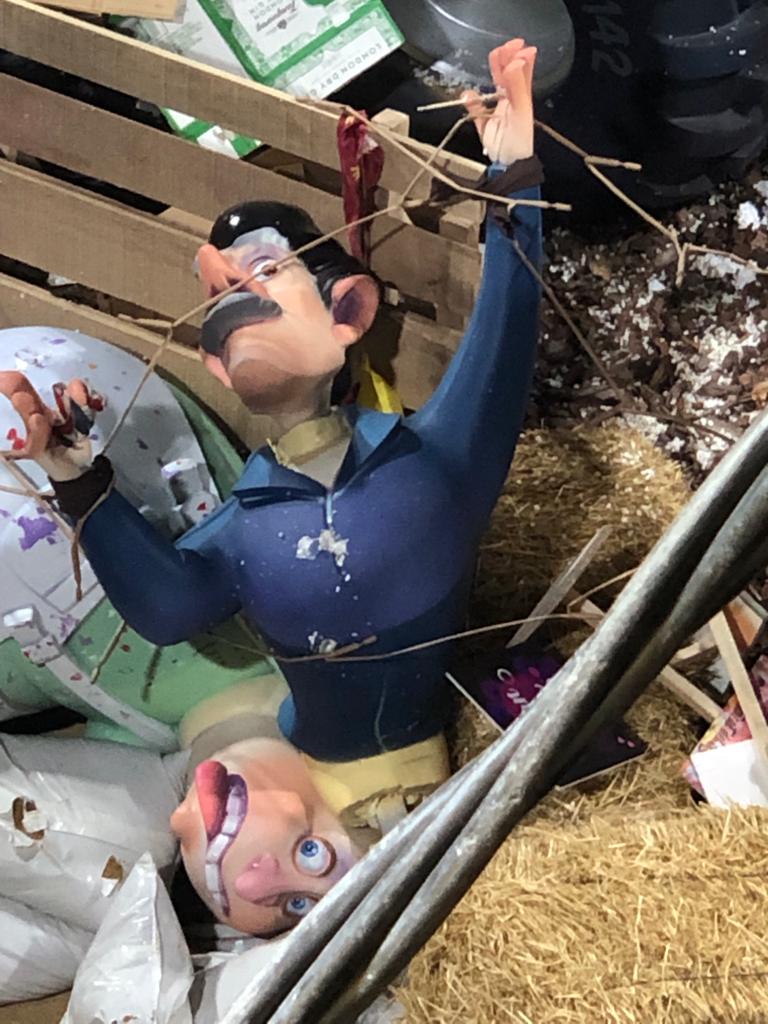
I left town on the afternoon of the 19th, but Jan and Tom shared the following photos with me and commented that the apartment didn’t smell great after the Crema (burning). Please note that the ninot that was on the balcony below Paul’s was knocked down before the fire and became part of the bonfire.

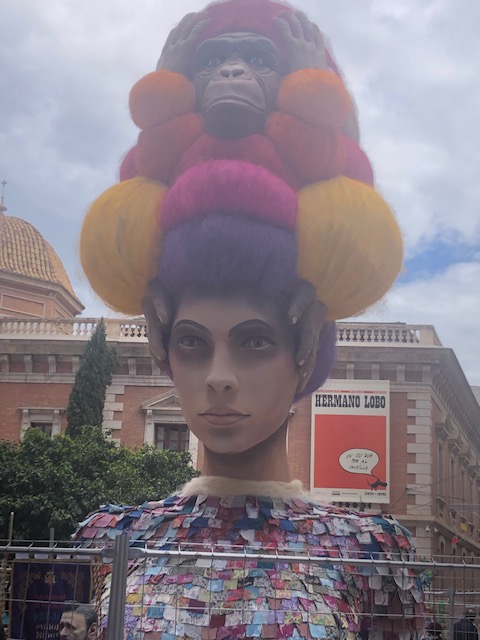
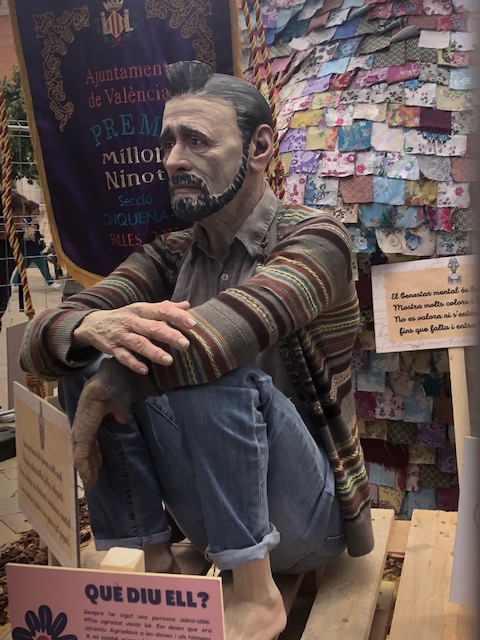
The ninot that was saved this year (as far as I know, based on the prize it won) was my favorite as it is extremely realistic. This was part of a larger Fallas that was quite artistic of a beautiful woman’s bust with colorful hair in which a gorilla was hidden who was covering his own and (magically) her ears. Note the dress is made out of fabric samples. Perhaps a take on hear no evil, see no evil, do no evil in reference to homelessness or unemployment… my interpretation!
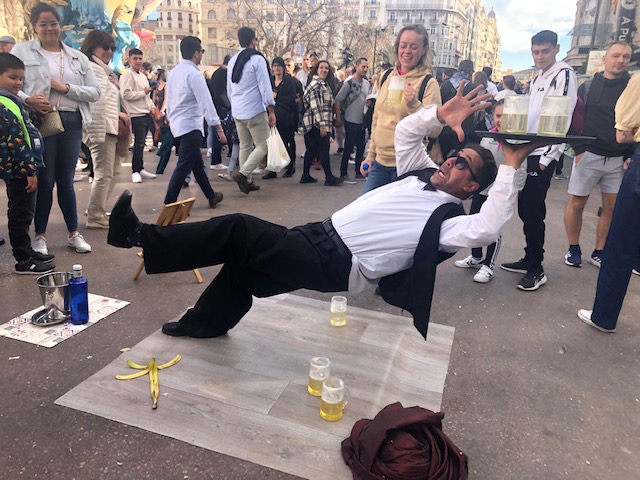
As a kick off to my travels, Las Fallas was amazing and I highly recommend it, but with several caveats. 1. If you hate firecrackers and/or are cranky after an interrupted night’s sleep, don’t come. 2. A refuge from the festivities is a must. 3. If you’ve done it once, you probably don’t need to do it again! And finally here’s a photo of a great living statue that we saw on the Plaza del Ayuntamiento, well after 2:00PM!
 duaime.com