I took a Blue Star Ferry (enormous car ferry) from Piraeus to Santorini in early April. The trip took almost eight hours, stopping very briefly at Naxos and Paros. An economy ticket entitled me to unassigned seating in salon spaces where there were tables and chairs and upholstered benches. I wanted to sit near the windows so I could enjoy the scenery, but the windows are so clouded with salt water, that it isn’t that enjoyable, and to be honest, you see a lot of water and not much else. I ended up settling on the benches as you could actually stretch out and nap there and then walked over to the windows as the ferry approached island stops.
When we arrived in Santorini, passengers were shepherded down to the car area and we watched as the huge drawbridge like door was lowered. This was happening while the boat was still reversing to reach the dock so it felt pretty exciting. The port is at the foot of a steep cliff and there is little there, other than a strip of restaurants and car rental places. Tons of drivers were there to pick up guests for their hotels and I eventually found mine. It took about 30 mins just to drive up the windy roads to the top of the cliff due to the heavy traffic.

After about 40 mins, we arrived in Perissa where I was eventually handed the keys to a little white Kia and shown my hotel room (which was just above the rental car agency). I had booked an “apartment” so had a mini-kitchen in addition to the double bed and a single pallet type bed. There was a nice patio area and windows out of two sides. From one window you could get a glimpse of the sea and very nice views of the sunrise. All good, until I sat on the double bed and my butt sank to the floor! I ended up putting all the blankets onto the single bed as cushioning and slept for a week on a very hard, but at least supportive, single bed.

The village I was in was not living up to my romantic expectations of Santorini, so the next day I headed off to explore Fira, Imerovigli and Oia. These are the towns that face the caldera (more about the geology soon) and they have the stunning views and the white villas clinging to cliffs. The places I passed on the way there were relatively scruffy looking and I was surprised to see that continue even within the fancier towns. You could tell that behind the walls, there were some very high end accommodations, but the infrastructure didn’t match those.

I did eventually find the pedestrian areas which were teeming with tourist shops, high end clothes and jewelry shops. There were also lots of restaurants, some with dining rooms overhanging the drop of the cliff face down to the sea. There was a cable car to go to the bottom, but I’m not fond of heights or very trusting of machinery so didn’t choose to explore that option. Although I had a pleasant lunch and enjoyed strolling looking at the things for sale, many of them were still closed as it was what they called “shoulder season” between low and high season. I didn’t mind missing out on a few shopping and dining options, and I was VERY grateful that I wasn’t there in high season as the narrow alley ways were teeming with tourists and I can only imagine how unpleasant that would be at the height of the season in the heat. I didn’t stay in Oia for the famed sunset and was much happier to return to my scruffy little village!

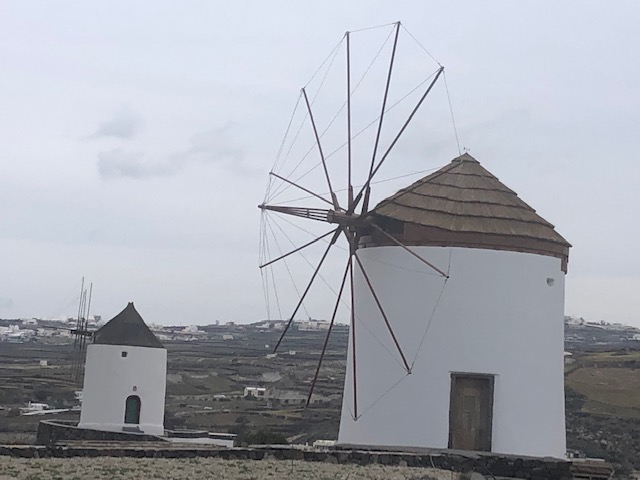
I saw some wind mills along the crest of a hill in Emporio and drove out to them. Some had been restored, but many were in ruins. They had once been an important part of the economy and culture grinding wheat into flour and often functioning as a bakery as well, but these days they are usually airBNB rentals.
You can also see the iconic white churches with blue roofs. I wondered if there was reason for this and learned that actually it is a government rule (1967) that houses be painted white and churches have blue roofs to act as a reminder of the blue and white Greek flag.

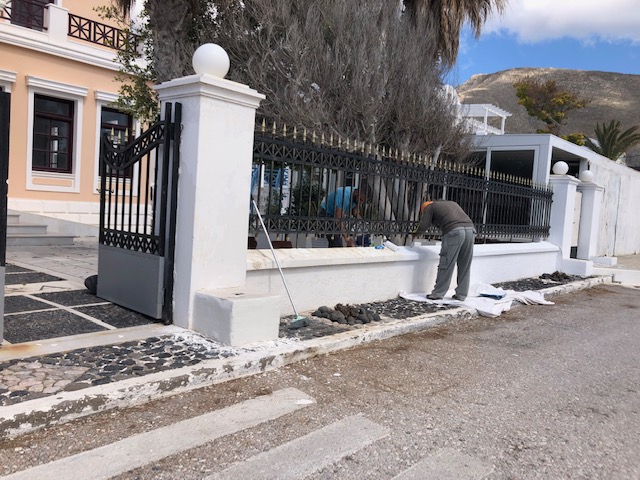
I saw these men painting the fence white and stopped to ask how often it needed to be painted and they told me it was an annual chore. Wow!
I explored two villages that I preferred as they seemed to have a better balance between the needs of tourists and the authenticity of a Greek village. One is Pyrgos, which has some quite nice restaurants (Agaze and Brusco) and a small castle at the top of the village. If you want to go farther up a windy hill you can visit the monastery of prophet Elias and enjoy the views. The other village that I liked was Akrotiri. It also has some great caldera view hotels, decent restaurants and an amazing museum!
So a bit about the geology of Santorini. It was initially formed by the activity of four volcanoes and was an almost circular shape. Continuing volcanic activity caused it to change shape creating a C shape with a volcanic island within the C. 1600BC there were about 30,000 people living on the island (double the current population). The eruption released 60 kms of cubic meters of matter. As a result there was a global darkness that lasted two weeks and global temperatures were lowered by four degrees for two years. The island was broken into 4 land masses and sixty meters of ash settled on the islands extending the shores by 1-2 kilometres (Google Santorini Volcano History for a 5 min. video).
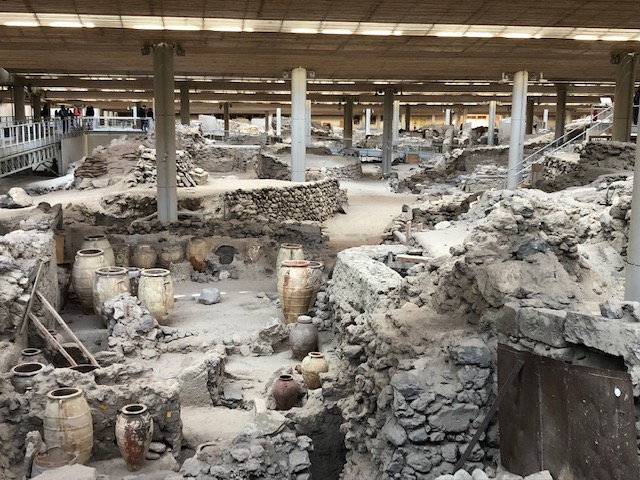
In Akrotiri, due to this volcanic explosion (similar to Pompeii) there is a village that was buried under the ash. The archeological dig there has discovered evidence of human habitation that dates back to the Neolithic Age (4500 BC). Unlike Pompeii, no human remains have been found as there were significant earthquakes before the eruption that gave inhabitants sufficient warning to leave. The whole dig area is covered with a permanent roof and there are walkways around and through the area for tourists. I highly recommend this, though all you see are the remnants of the homes and the lay out of the streets and water/sewage systems. All of the decorations and utensils that have been discovered are either in Athens or in the small prehistoric museum in Fira. The dig has been going on for 40 years and is expected to take a total of 200 years! I suppose when you are moving cubic meters of ash with nothing but brushes, it takes time!
The island is very rocky and hilly and so anyone who wants to hike has lots of options. I tried to reach a prehistoric ruin that was located in the hills above the village of Perissa, but gave up before reaching it. I did enjoy the views though!
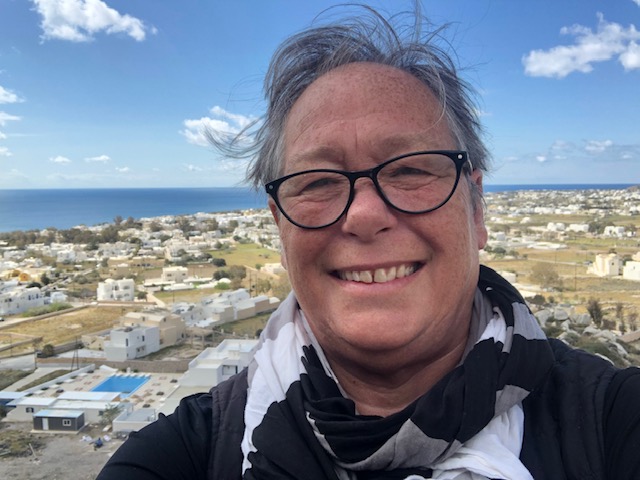
So that’s about all I have to say about Santorini. In summary: Unless you have lots of money and all you want to do is sit in your villa, dip in your pool and enjoy a stunning view, skip Santorini. If you do go, don’t go at high season, and rent a car so you can explore off the beaten track and enjoy hikes and exploring smaller towns. I also need to say that I didn’t have great weather and wasn’t sleeping well on my hard bed, so that may have influenced my experience!
1613 BC
 duaime.com