I was intent on going to Meteora, a cool site in northern Greece where there are monasteries perched precariously on rock outcroppings, and had booked a hotel there well in advance. As the time approached however, I realized that getting there by train as I’d planned was not going to be possible. A terrible train accident that killed 57, mostly college students, had caused the train line to suspend service. I then started to look at bus service, but the days I was planning to be there actually fell on Orthodox Easter and buses were either full as Athenians travelled to return to their villages for the holiday or not running. I was left with only one option, a bus tour for tourists with a stop on the way at Delphi and then an overnight before seeing the monasteries. I have made it to the ripe age of 65 without ever going on a tour bus (except as a student), but if this was the only way, so be it!
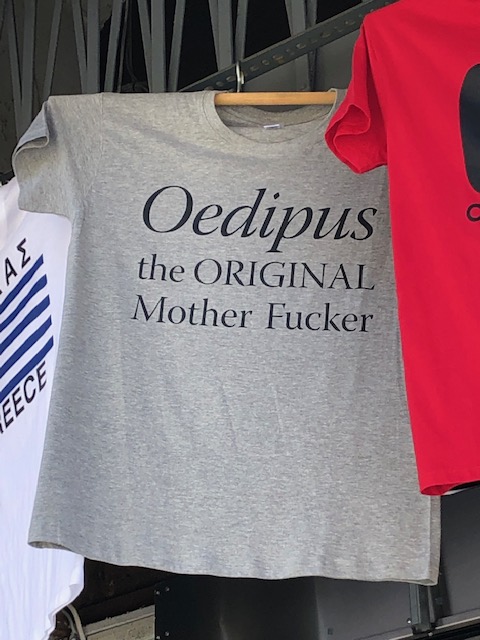
I was supposed to meet the tour bus at 7:30 outside a hotel near my AirBNB. It arrived on time and only had about 10 people on a full sized, quite modern bus, so I thought this was going to be better than I thought. However, we proceeded to go from hotel to hotel for an hour picking up more passengers and even dropping off some to catch other tour buses. We finally headed out of Athens at 8:30 with an almost full bus (as a single traveler I was allowed to keep two seats, but most seats were full). We drove for 3.5 hrs with the charming tour guide telling us Greek myths and Greek history all along the way. We passed Thebes, birth place of Oedipus, on our way to Delphi which is where his father was given the prophecy that his son would kill him and marry his wife, giving rise to this T shirt slogan!
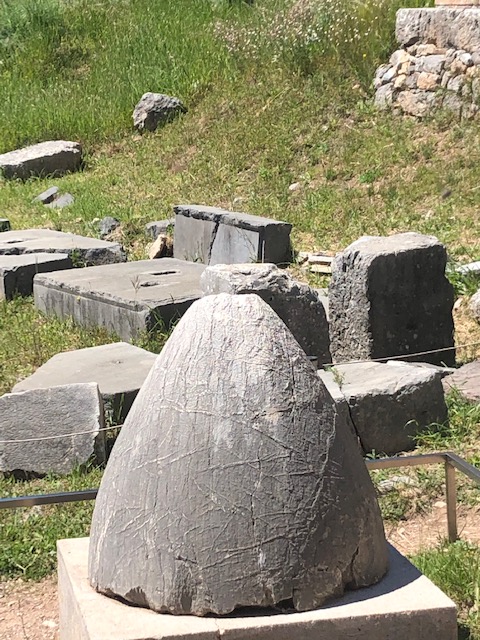
Delphi is located on a mountain over 600 meters high and to get to it, you have to walk up irregular height steps and steep inclines made of rocks. The first 100 meters were actually the most challenging, so power through if you can! Apollo chose this site for his temple as it was considered the “belly button of the earth”. This was based on setting two trained birds to fly one from the top of Greece and one from the bottom and Delphi is where they crossed, therefore it was the center of the world! This statue represents the navel of the world: clearly an outie!
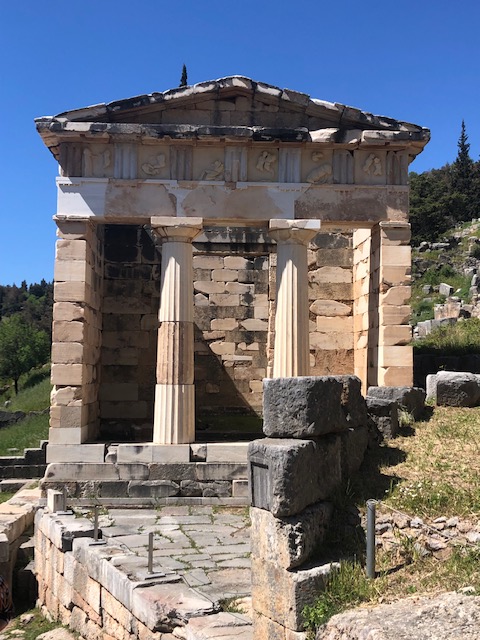
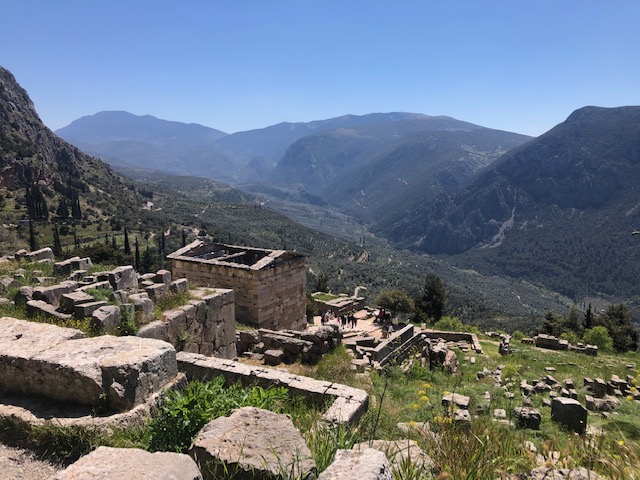
I only made it up to the temple itself, but throughly enjoyed sitting in the sunshine and admiring the views of Greeces’ largest olive forest in the valley below as well as people watching the many tourists who were making the climb. Not much is left of the temple itself is but there is an almost intact small treasury (with a stone roof and all) in which some of the offerings were stored and it is quite beautiful.
The oracle of Delphi was a vital influence on decisions both at a personal and city-state level for over 1000 years from around 1800-600 BC. Oracles were only delivered nine days of the year. If you wanted a prophecy, you were expected to bring minimum two gifts: a goat and something to eat. The goat was to be washed at the entrance of the compound and if when wet, the goat did not shiver, you would not be granted an audience. If you made it past that gateway, you would ascend, passing all the gifts given by grateful supplicants whose prophecies had been positive and come true, as a visit to Delphi was also followed by a second visit at which time gratitude needed to be expressed in a concrete (or marble, or gold…) fashion.

Apollo took over the site of Delphi from a prior deity called Gaia and to honor her, he said the head priestess, who supposedly made the prophecies, would be a single women from the nearby village. They were assisted by priests. On a prophecy day, the priest would meet the supplicant and hear their question which they would relay to the priestess. The priestess would prepare by chewing bay leaves (poisonous ones) and go into the cellar of the temple where there was a crack in the earth which released sulphur and other chemical gases. Breathing in this poisonous air would cause the Priestess to start babbling. The priest would “interpret” this nonsense into a non-committal “prophecy” which needed interpretation by the supplicant. In this way, if the prophecy didn’t come true, the blame would be placed on the interpretation, rather than the prophecy itself. So of course, the real power, rested with the male priest, not the short lived high priestess!
After visiting Delphi, some of us boarded a different bus, with a different tour guide and joined a group that had already been touring for 3 days. We stopped at a restaurant which seated about 10 bus loads at the same time. Food was awful and the noise was overwhelming, but I managed to make the acquaintance of my seat mates, two Australian couples. Back on the bus, we drove for a further 3 hours to reach the town of Kalambaka, located right below the monasteries we had come to see. The hotel was fine (though no hot water) and the food was awful, which I guess is par for the course on a bus tour. It’s is hard for me to understand why people choose to go on holidays where they give up the right to make their own choices and end up with eating and sleeping conditions below what they would put up with at home. You don’t even get to choose when and where you pee! When I travel, sometimes my choices are great and sometimes they are awful, but they are mine. Maybe this is just another aspect of being a control freak, but I sure prefer my way!
The monasteries were built as some monks felt that the monasteries they had been in on Mt Athos were overcrowded. The monks who moved to Meteora were trying to find a place where they’d be left alone to their meditations, so they chose the most inaccessible spot they could find to build on. The rock promontories they chose were formed when what had been a very deep lake (two kilometers deep!) suddenly drained due to an earthquake opening one end of the lake. What was left after the erosion of the draining were these enormous columns of sedimentary rock which rise precipitously from the ground.

At one point there were 24 monasteries, each with 200 monks. They supported themselves by farming the rich land in the valley below the rock promontories. The only way to access the monasteries was either from a very tall ladder or by a basket that was lowered. This required a leap of faith as the rope was only replaced “when the lord let them break”!

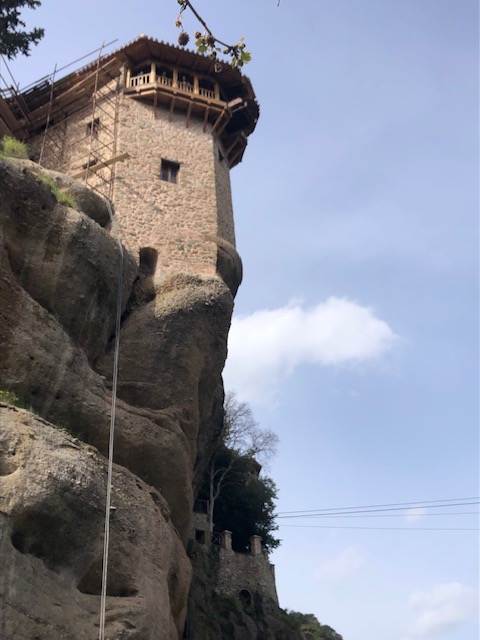
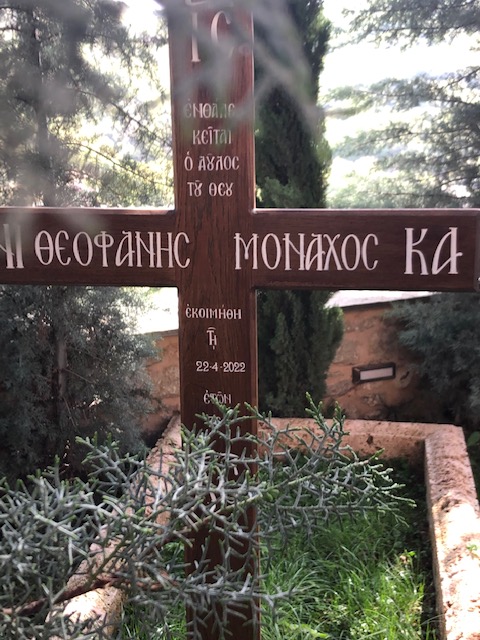
Today there are only 7 monasteries and they are struggling to find enough monks to keep them running. Most of them have 10 or fewer monks living in them and rely on volunteers to help run them. In the 20th century the monasteries became funded partially by the state and access was created either by building bridges, steps or even a cable car! They are however active monasteries and though tourists are allowed access, the open hours are strictly limited so the monks can withdraw. We were informed that women must wear dresses, no photos are allowed and on the day we went, it was Good Friday, we had to be completely silent (which our tour guide was very irritated about!). We saw the grave of a monk who had passed away in 2022 and who had reportedly never seen a woman! I went back to take this picture but waited until the little boy who was peeing on the grave was done. At least it wasn’t a girl!
We went to three monasteries and in one of them the frescoes had been recently renovated and were too brightly colored for my taste, but the other two were quite beautiful. The sacred areas tended to be in three sections: one area that the lay people could worship in, one where the monks would be and one where the service would be held. Each one was a step higher than the other and each got brighter (more light) to represent the elevation and enlightenment of faith.
The setting of these monasteries is truly stupendous and worth seeing! In summary, Delphi and Meteora are great destinations and if you can get there without joining a tour bus, I highly recommend you add this to any visit to Greece, as long as you don’t have severely limiting mobility issues.
 duaime.com