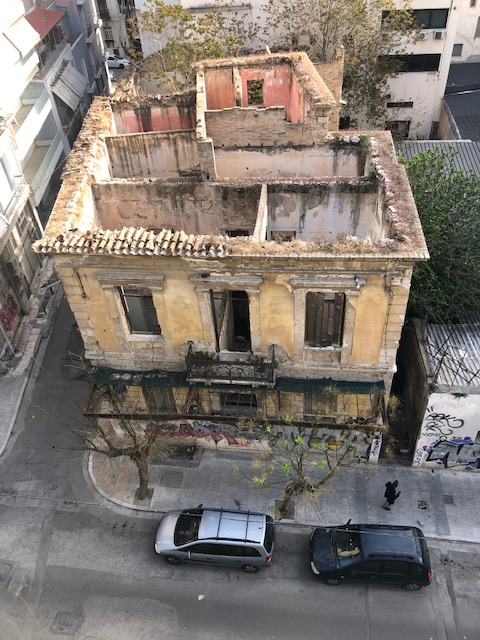
Athens is a large (4.5 million), gritty city in which half of the population of Greece lives. Even the wealthier, more touristy areas have abandoned, roofless buildings, but it didn’t feel like a dangerous city to me (view from my airBNB).
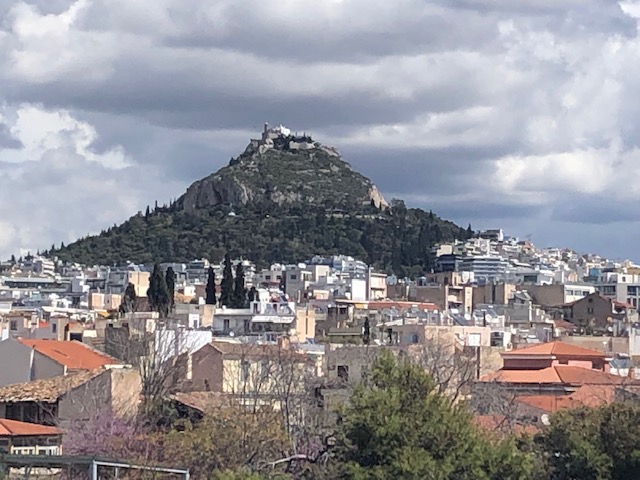
The Acropolis dominates the center of the city and there are several other towering outcroppings within the city limits. Around the outskirts it is ringed by mountains.
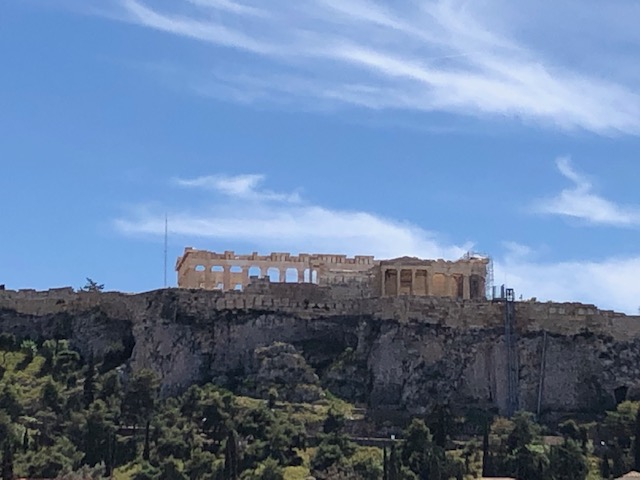
The acropolis is truly breathtaking and I was lucky to enjoy a sunset view of it from the rooftop bar of the Grande Bretagne Hotel on my first night. The Grande Bretagne is located on the same square as the tomb of the unknown soldier at Syntagma Square. I got to watch the changing of the guards. This is similar to what happens at Buckingham palace, but here the uniform has little pom poms on the shoes and the march has a very odd step where they raise one leg and stretch it like a sloth, then swing it like a horse pawing at the ground. Each step is then marked by tapping the rifle on the ground. Hard to understand how and why such a tradition came about!
All around the base of the acropolis are other Roman ruins (amphitheater, library, etc…) and I can only imagine how difficult it would be to get any kind of building permit! I was amazed to see this train line running right through a park literally littered with Roman ruins. Many of the streets around the foot of the acropolis are pedestrian only and are lined with restaurants and everything tourist souvenir possible.


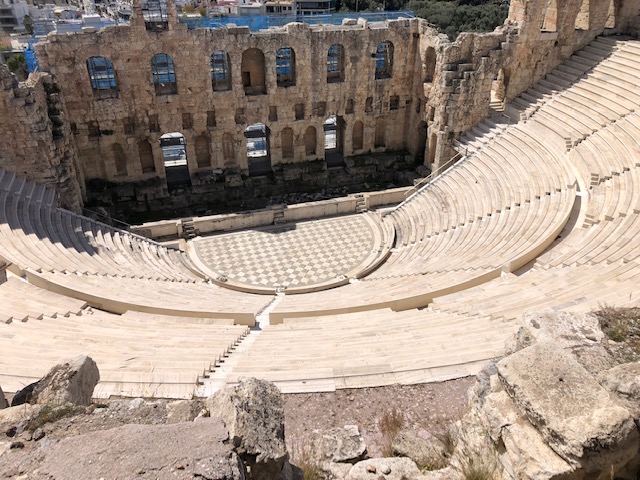
Directly outside the museum is one of the entrances to the Acropolis, and when I was there, the lines seemed shorter than at the main entrance on the other side. Even though I wasn’t there during the high season, the lines were long and so I recommend buying your “skip the lines” tickets online beforehand or hiring a guide who will be able to buy the ticket for you without waiting in line. The guide cost 20 euros plus the cost of the ticket. Well worth it. The walk up is about 20 min. climb, but it is manageable and worth doing. the path goes past a beautiful amphitheatre that has only been excavated in the past 20 years or so.
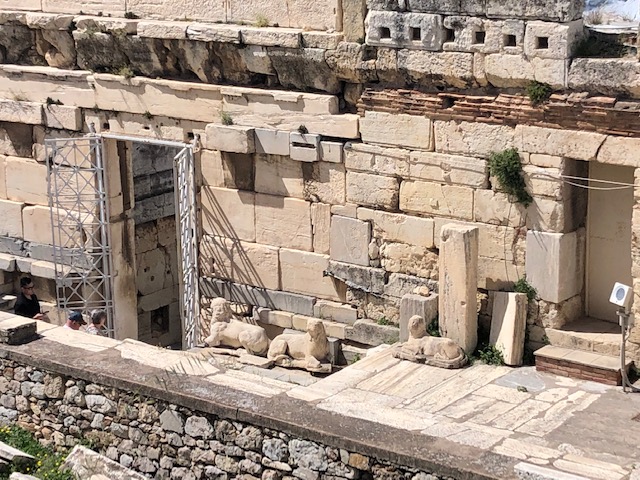
At the entrance is the place where the first popular voting took place and this is hailed as the invention of democracy. The first vote was about which God should be honored by having the city named after them: Athena won. Every decision was put to a vote and therefore voting took place every nine days. Anyone who didn’t vote was considered not to care about others, only about themselves (id) and were therefore referred to as “id-iots”. I guess that still holds true to this day.
The new Acropolis Museum has an impressive collection of most of the statues and friezes from the Parthenon and the other buildings on the Acropolis. They are beautifully displayed and well labeled in English, but I felt that I should probably have gotten a guide to get the most out of my visit. It is located right at the foot of the Acropolis and has great views of it from the restaurant on the roof terrace.
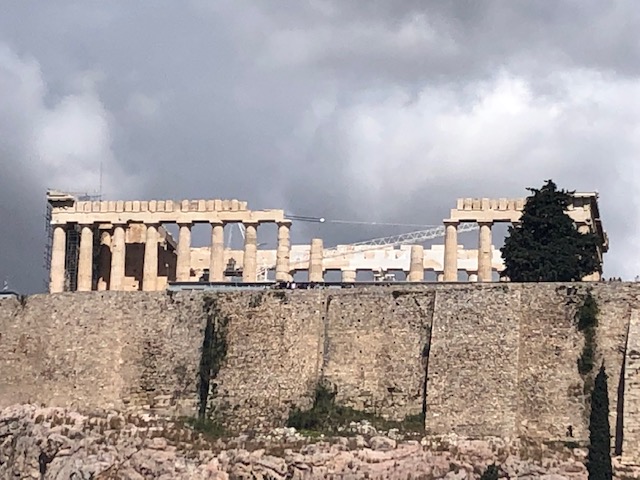
Multiple mathematically calculated tricks were used to make the Parthenon pleasing to the eye. The parthenon uses the “golden ratio” of 4:9 so it looks very proportional. Another trick to make it look like it rises naturally from the hill is that the columns are slightly bent inward to counter the effects of an optical illusion. When viewed from a distance, a perfectly straight line would appear to sag, whereas the temple’s curvature would counteract that illusion. They also knew that columns standing in a long row often looked as though they curved in the middle. To prevent this optical illusion, they made their columns bulge slightly in the middle. As a result, the parthenon’s columns look perfectly straight. I wouldn’t have been able to tell any of this without being told, but when I saw a column next to a straight section of scaffolding, it was obvious!
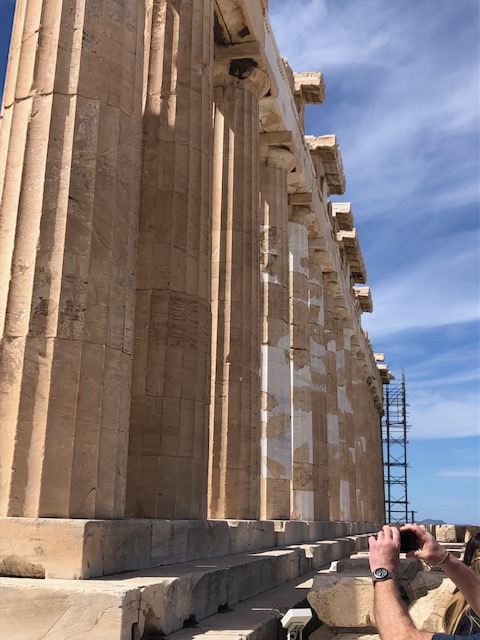
The white parts of the columns are new marble, dug from the same quarry as the original, but not weathered for 2500 years! It only took nine years to build and it has been under renovation for 40 years, and is nowhere near done. Everyone who worked on it, even the slaves, were paid as they only wanted positive energy to infuse the project. The Parthenon was basically undamaged until it was bombed by the Venetians in 1688. The damage was compounded by the fact that the parthenon was used to store gun powder!
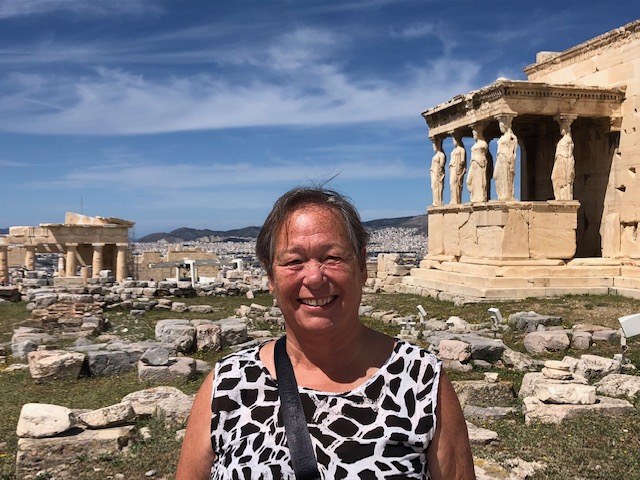
My favorite building of the Acropolis though was the porch of the Maidens on the The Erechtheion, a temple dedicated to the goddess Athena and the god Poseidon-Erechtheus. The porch roof is supported by the six caryatid statues of full figured women. The originals are in the new museum, but there are reproductions at the temple.
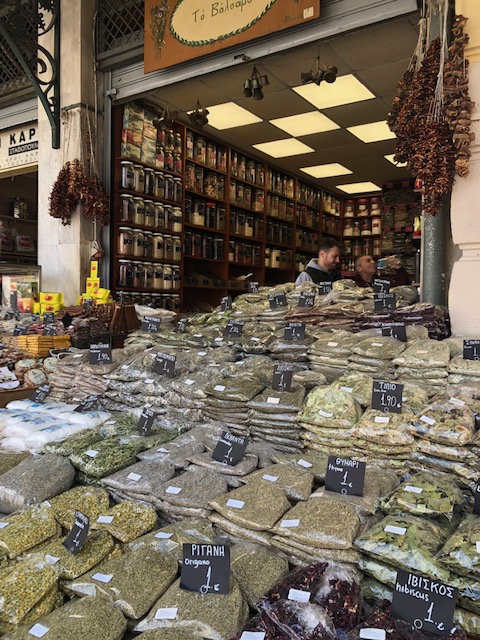
I spent a day walking around less touristy areas as I was shopping for a new carry on suitcase. I found several open markets and the central meat and fish market, as well as this beautiful spice shop.
But I wasn’t really in the mood for a big city and I’d already been in Greece for a month, so I decided to head off after only a few days. There is a train line that goes from Athens to my next stop, Sofia Bulgaria, but due to the terrible accident the service was suspended and I decided to fly instead. My flight wasn’t until 6:00pm, so I arranged for late check out from my hostel. There are two codes to get into the hostel: one at the main door to the building and another code for entering the lobby of the hostel, and another for the individual room, so I asked them to be sure to keep my codes active until after 4:30pm. Just before leaving, I decided to pop out for a bite to eat and left my phone in the charger as I wanted to be sure to have enough power left when I arrived in Sofia, just in case check in got complicated. It was Orthodox Easter and I worried things would be closed, but I did find a restaurant with a take out counter.
When I got back, my code to the building didn’t work, but someone else opened the door so I got in. But then the door to the lobby didn’t open and no one came when I knocked (banged actually!). I went back downstairs as I had to find someone who’s phone I could borrow (I had the hostel phone number written in my notebook). Eventually a couple from Singapore who were just checking in came. They didn’t have any of the codes, so were glad I had the number to call. Finally, with the help of the person on the phone we got in. By then, it was time for me to leave to the airport and, a bit flustered, I grabbed my luggage and left. As I waited for the elevator, I went through my usual mental checklist: money, cards, passport…!!! Oh no, I had left my money belt with passport and extra credit cards in the safe in my room, and now the door was locked. This time, my code did work and I was able to get back in, but what a scare!
And then, getting out of Greece at the airport was surprisingly complicated. At the passport check, they looked for my stamp into Greece and didn’t find it.
“Did you use another passport”
“No, I showed an expired passport in my married name at the check in counter, as my ticket was in my married name (my divorce is recent), but that I did not use it when I went through passport control.”
“Where did you fly from?”
“Barcelona”
“When did you enter Spain?”
“By car on March 15th, and there was no passport check.”
“Where were you coming from when you entered Spain?”
“From France where I’m a resident”
“OK, show me your residency card.”
“Sure, but it is in my married name. Oh and it’s expired, but I have a document stating that my application for an extension was successful.”
Etc… etc…
Travel is never easy but when you’re transitioning from one life to another, it is especially hard! By the end, the guard and I laughed as he accused me of drip feeding him what he needed, and finally he stamped my passport!
 duaime.com