I arrived in Sofia late on Orthodox Easter Sunday and when I started to explore the city the next day I was amazed to see empty streets. Turns out the day after Easter is also a holiday. The neighborhood had lots of bars and graffiti (loved the name of this tattoo parlor), but also a pedestrian mall area (I appreciated this statue), some truly beautiful buildings and lots of parks.


I made my way to the St. Alexander Nevsky Cathedral which was surrounded by police officers and cars. I asked what one of them what they were doing there (didn’t want to enter the cathedral if there was a bomb threat or something) and he said cryptically, “football”. I guess it can get pretty rowdy!
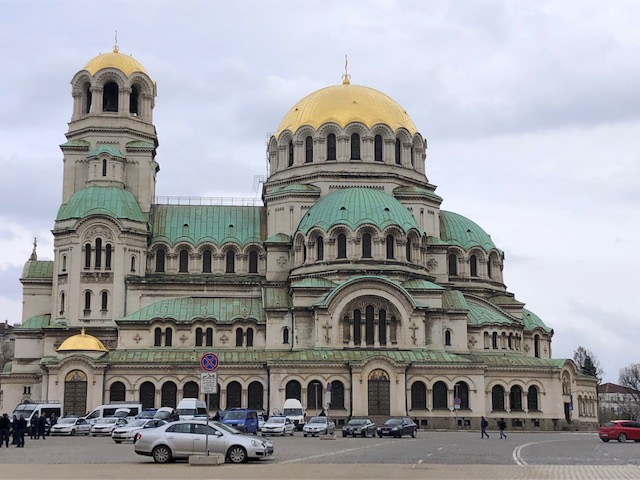
Inside the cathedral a mass was in session with a full choir. Interestingly, there was no seating in the nave, all the congregants were standing. The decorations were quite ornate with lots of frescoes and the priests were dressed in gold brocade.
As I walked toward another small spire I could see from the Cathedral, there was a man selling communist era memorabilia. I was sorely tempted by a pin that identified a nazi guard during the 1936 Olympics at which Jesse Owen equaled the world record (10.3 seconds) in the 100-meter race and broke the world records in the 200-meter race (20.7 seconds) and in the broad jump (26 feet 5 3/8 inches), thus challenging the notion of Aryan excellence. But, the vendor wanted 70 euros and I didn’t feel right about owning Nazi memorabilia, so I resisted.

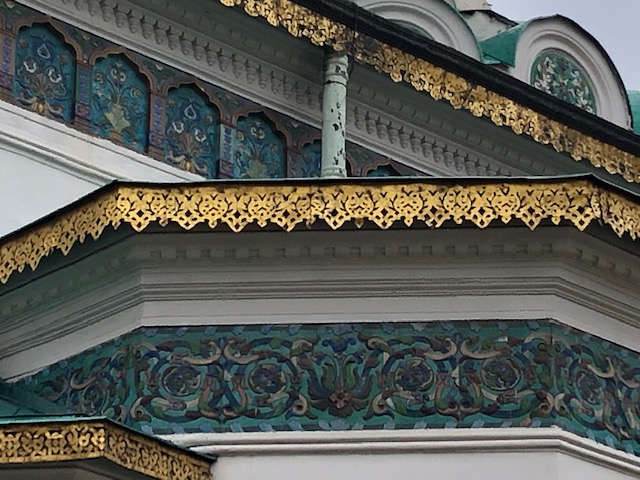
The smaller church was St Nicholas the Miracle maker and it is a Russian Orthodox church and was funded by the Russian embassy. I was really impressed by the beauty of the exterior, especially the trim.
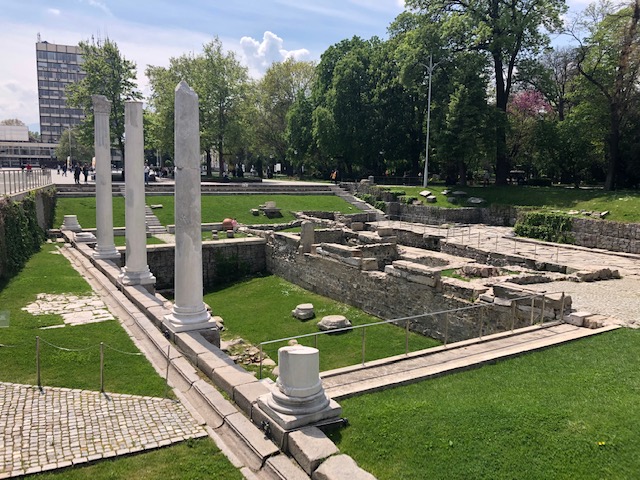
As I walked around, by chance I came across an archaeological site in the middle of the city. These are the remnants of the city of Serdica which flourished from 2000 BC when the Thracians founded it until it was taken over by Rome. You can see sections of the ancient city in several places in modern Sofia. Serdica is famous for the Edict of Serdica, also called Edict of Toleration, which was issued in 311 by Roman Emperor Galerius. It actually marks the beginning of the schism between the Eastern Church and the Western Christian church.[10]

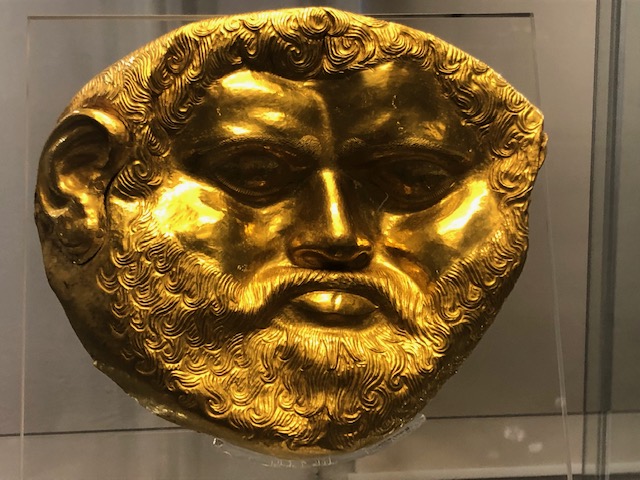
I highly recommend the National Archeological Museum. It has an amazing collection of artifacts that were found, mostly in Bulgaria though there were a few from Macedonia. Apparently Bulgaria has been home to Homo Sapiens as early by 45,000 years ago. In the museum, the most impressive collection to me was from the 5th century BC. The number, condition, quality and variety of what was on display honestly put to shame the things I saw in Greece and other major European museums. I’d love to find out more about why so many items were still available to be excavated. From my research it seems that many of the most amazing finds were accidental as farmers worked their fields between the 1920s and 1940s. I’m not sure what conditions made it that they had not been damaged or scavenged long before this. There were very delicate and creative works from the iron age and lots of gold from the Thracians civilization. Not to be missed!
Although there is a metro system (4 lines), lots of trolleys and a bus system, I mostly moved around the city by foot or taxi as they weren’t very expensive and allowed me to save my energy/aching feet for actually looking at things I wanted to see, rather than on getting to them. Although I knew to insist the driver start the meter at the beginning of the trip, on one ride, the meter seemed to jump from the equivalent of 4-5 euros to 17 euros! I argued with the driver, but eventually gave in. They must have a button they can push during the trip when they have someone they think they can trick in the car.

In general I found the Bulgarians to not be very friendly or helpful. There were fewer people that spoke any English, which probably contributed to this impression, but even if you don’t have a shared language, it is possible to smile and shrug your incomprehension rather than just say no or turn away. It was even a challenge to get some people to stop to hear my question. This was also true at the international window of the train station where I went to get my seat reservations for my first trip using my train pass. I eventually used a translation app and approached another teller window and got what I needed. The few people I spoke with seemed unhappy with Bulgaria’s economic situation and when I told them I was from the US they said, “Oh, you are rich!”. I actually ended up changing my stock answer to, “I’m from France” to avoid this.
On the way to the train station the day I left, I took a taxi and the same meter jump trick was used. This time I actually spotted the moment that it happened and I called him on it immediately. I said, “If Bulgaria wants more tourists, this will stop them”. We weren’t near the station yet and the meter read 20 and I refused to pay and told him to pull over so I could get out. He started to negotiate with me and I finally agreed to pay a total of 15 for the whole ride. He wanted to be paid right then and I only had a 50, so he took it and went into a shop to get change. Since I was in his car, I figured he had to come back, but I hopped out and took a picture of his taxi license and registration. Then I thought he could just drive off with my suitcase when I got out (it was in the trunk) so I took his phone out of the charger and held it on my lap, figuring I’d give it back once I got out at the station and had all my bags. On the way to the station, he realized his phone was missing and was searching for it as he drove and at each stop light. Luckily, it never occurred to him that I would have taken it! When I disembarked I gave it to him and said, “you steal from me, I steal from you!” It was all quite nerve wracking, but I felt good that I didn’t just take it lying down.
PLOVDIV
When I got to the station to catch my train, it was easy to find my train on the departure board by the departure time, but it was not clear which track it would be on as all the other labels were in the Bulgarian Cyrillic alphabet. I ended up dragging my suitcase up and down stairs as I first went to track 3 (as indicated) only to be directed back to track 1 where I had started. This could easily have been avoided with a little labelling in English (alternating languages as they do on most electronic displays).
The train between Sofia and Plovdiv took about 3 hours and my compartment was full both coming and going. There was little to no conversation, but there was a man in the next compartment who was very loudly ranting about politics (I think…I could decipher occasional words like democracy and America). At one point, one of the women in my compartment stood up and went next door to close the door of their compartment. No one said a word, but it did reduce the volume considerably!
Plovdiv is the second largest city in Bulgaria. It is the cultural capital of Bulgaria and was named the European Capital of Culture in 2019. Plovdiv is the oldest continuously inhabited city in Europe. There is evidence of habitation in the area dating back to the 6th millennium BC, when the first Neolithic settlements were established. Philippopolis, as it was first known, was founded around 300 BC by the king of ancient Macedonia and became the home of Macedonians, Thracians and Greeks.
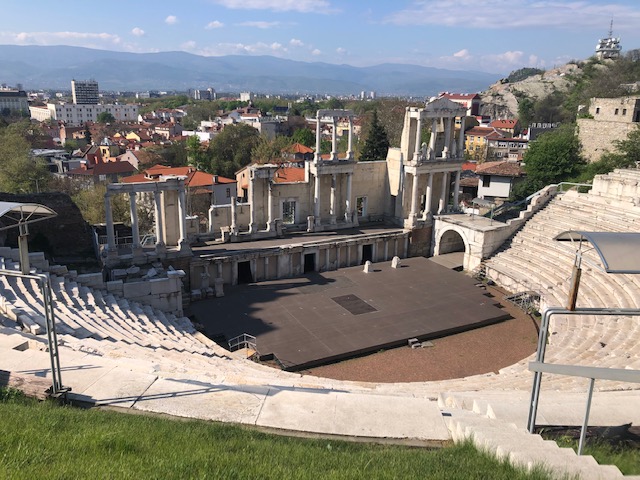
Ploviv is surrounded by peaks up to 250 m high and is often referred to in Bulgaria as “The City of the Seven Hills”. The original settlement was on top of one of these and there is a beautiful amphitheater overlooking the modern city. But with time, the city descended into the flat valley below and everywhere I went in Plovdiv, I bumped into more ruins: remnants of a stadium and a forum, as well as other unidentified sections of wall.

In the 1800s Plovdiv was one of the major economic centers of the Ottoman Empire and the beautiful wooden homes built during that period form what is known as old town.

I especially liked this bronze outside the school of arts in the old town. It reminded me of photos we took with a frame at my 50th birthday party!

I looked up the museums of Plovdiv on my phone and didn’t see an archeology museum, but luckily knew there was one as it had been mentioned at the Sofia museum. I finally found some signs to it and went in. I was again impressed not only with the artifacts displayed, but in this case, the museum also had clear and helpful labeling, mostly bilingual, so it was easy to appreciate the rich offerings. There was a bit more information about how some of these discoveries were made. These three (maybe identical?!) brothers who were farming their land found a treasure trove of gold and ceramic in the 1940s and handed it over to the authorities.

This vase and platter were the most impressive and can be seen in the photo of the brothers, but there were more than 20 similar items in all.


The story that tickled me most, probably because I’m a primary school teacher, was a discovery in 1988 by three kids: a third grader, a fourth grader and two fifth graders. Their find wasn’t as amazing as the three brother’s as it only consisted of three golden necklaces and a ring, but I wish I could have eavesdropped on the conversation of those kids as they tried to decide what to do with their find!
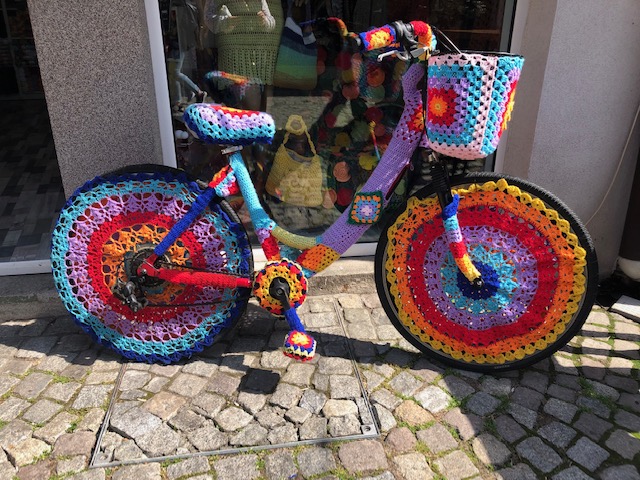
There is a large area which is mainly for pedestrians called Kapana which abounds in restaurants and bars. I had read it was the artistic district, but I really didn’t see much evidence of that. There were some shops selling “art” but it was either artisanal/crafts or really touristy stuff. Not my taste, though this crocheted bicycle cracked me up!
Speaking of which, I was lucky to have some recommendations from a friend or a friend on where to eat in both Sofia and Plovdiv, and tried a couple of those restaurants as well as several others. I’m afraid that Bulgarian food is not among my favorites. It’s quite meat heavy and what I would call “mystery meat” at that, ground up to make patties, rolls or sausages. The best meal I had was this one, at a restaurant in Kapana.

There also were soups/stews but I admit I didn’t try them as the ones I saw served to other tables didn’t impress me. I did have a nice banitsa, a baked pastry with white feta like cheese but even that was pretty greasy. So I admit I wasn’t very adventurous, but I also didn’t get much encouragement to take risks.
In summary, the ancient history of Bulgaria has left absolutely amazing artifacts in the museums and beautiful ruins in its cities. For those alone, it is worth a visit. Otherwise, however, it has a ways to go to be ready to welcome much tourism. People seem angry and the infrastructure just isn’t there yet.
 duaime.com