One advantage of having a car when you travel, is that you can stay in places that aren’t central and therefore pay a bit less for your accommodations. For example, I booked an AirBNB studio about 10 kms, from Dubrovnik in the Mlini, with a great view of the Srebreno harbor, for 40 euros.

What I discovered however when I drove to Dubrovnik to visit the walled city, was that parking was relatively expensive (10 euros) and was far from where I wanted to be and necessitated climbing a lot of steps on the return trip! I later realized you could get a round trip transfer boat ride from the Srebreno harbor to the foot of the walled city for 15 euros. This would definitely be the way to go! I’m sure the views from the boat would be fabulous, because the views from the coastal road were, though there were few opportunities to pull over and enjoy them.

I chose to use a Guruwalk tour guide for my exploration of the walled city, since I had done no reading and had no background on what I would be seeing. Guru walk is a good concept where you book a guided tour with a local and pay nothing until the end of the tour where your payment amount is up to you. I based mine on what I had paid in Athens and gave 20 euros for the two hours, and that seemed to please him. There were about 15 of us on the tour and they actually broke the tour into two groups (15/15) so there wouldn’t be too many of us. This must be hard to manage as I booked my tour only 2 hours before the start!
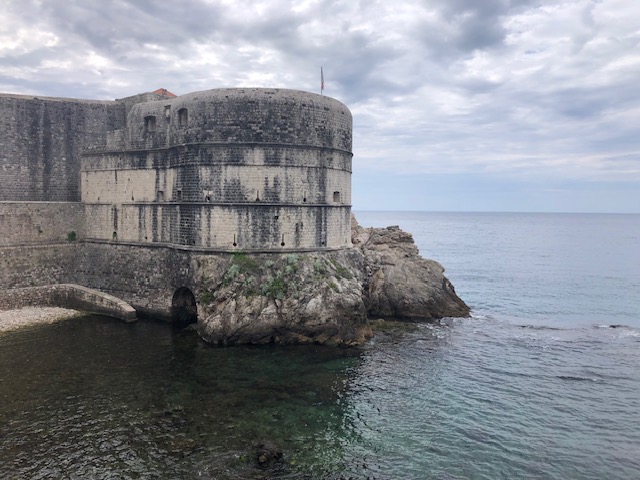
Dubrovnik is a UNESCO World Heritage Site in recognition of its outstanding medieval architecture and fortified old town. It dates back to the 7th century and from the 14th and 19th centuries, Dubrovnik ruled itself as a city state. This is called the Golden Age of Dubrovnik and the city has changed little since that time. It was an important maritime trader and at one point equaled the Venetians.
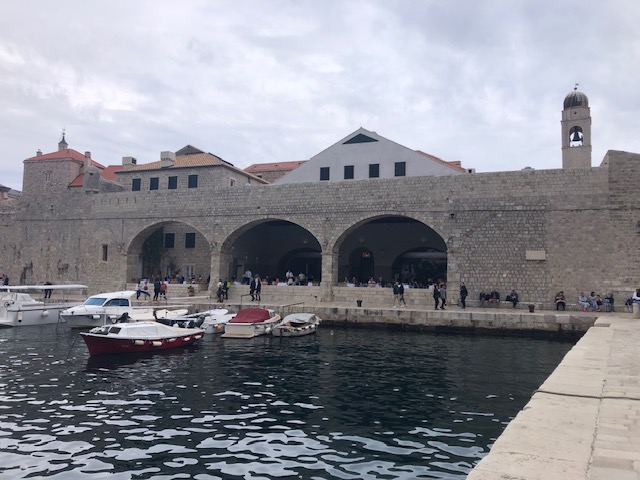
They made many important innovations. For example aqueducts to bring water to the city, a sewer system and they even instituted the first quarantine for sailors returning from their travels. They built this special building to contain the quarantined travelers, but the quarantine lasted only 30 days and was not very well controlled.

It was the Venetians who realized that it took 40 days from the first symptoms of the plague to appear until the death, so that was the extension of the quarantine and the source of the term. Dubrovnik also imported cats to control the rodent population as it was discovered that cities with cats had a healthier population. The second pharmacy in Europe (the first was in Florence) opened in 1317 in a Franciscan monastery in Dubrovnik.

If you are a fan of the Game of Thrones (I’m not) you’d be interested in seeing the Walk of Shame steps (modeled after the Spanish Steps in Rome). I was more impressed by the wit of the restaurant at the base of the steps called the Wok of Shame!

There was a half marathon along the ramparts of the fortress the day I was there so I wasn’t able to explore that, but to be honest, I might not have anyway. I was impressed by the runners running down these steps as part of the course!
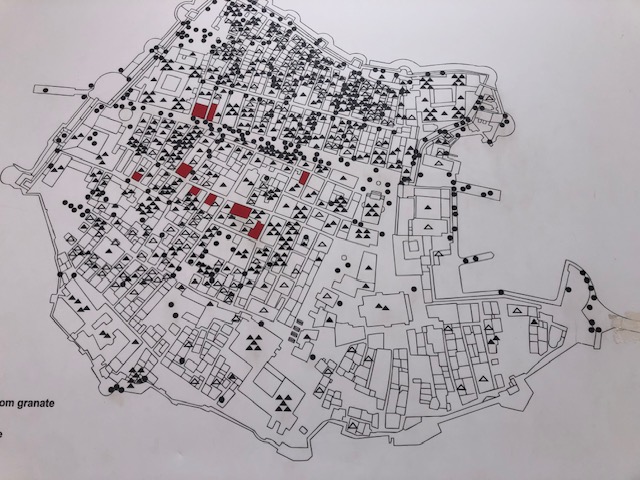
It was super crowded and Luka, our guide, explained that there are 8 million visitors per year who spend at least one night in Dubrovnik during the eight month “season”. In the low season, the city only has a population of 1500. When asked about any leftover tensions within the Balkan countries, he explained that many of the people working in restaurants and hotels come from Serbia and they all get along, but I did notice in several places around the city a display showing where the bombs had landed in the 1991 bombing of the city. Luka was born in 1991 and he said that for his generation, it was still a very important influence.
Dubrovnik reminded me of a cross between Carcassonne, a walled city on a hill with winding streets like Dubronik, and Aigues Mortes, another walled city in France that gives onto the mediterranean. Aigues Mortes and Dubrovnik are both larger than Carcassonne, coastal and both depended on their monopoly of salt production for trading.
 duaime.com